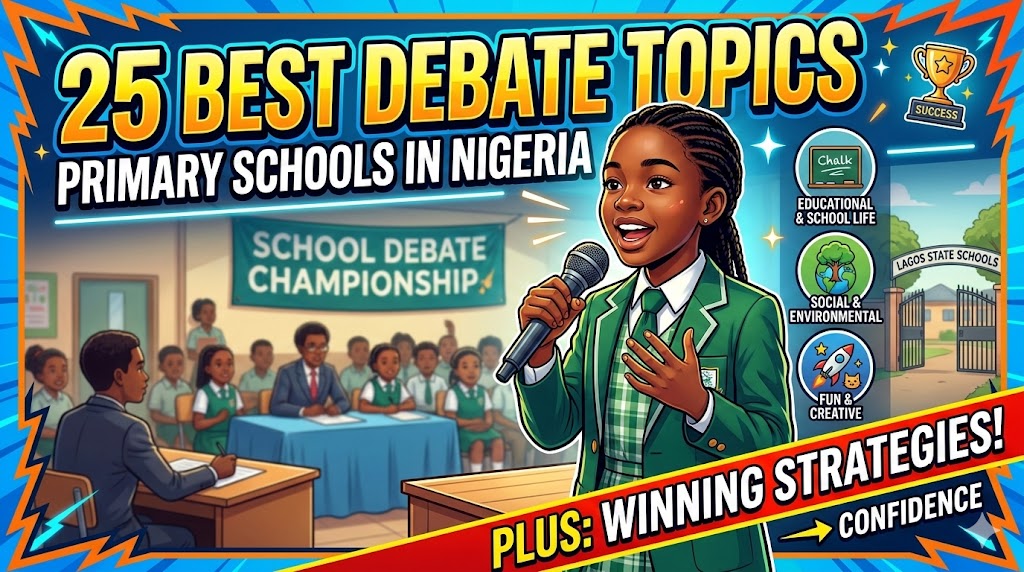
15 Engaging Debate Topics for Primary Schools in Nigeria (Plus Winning Strategies)
Watching a young child freeze on stage is heartbreaking. Stage fright is real. Kids freeze up. Parents stress out. Teachers scramble for ideas.
Finding the right debate topics for primary schools in Nigeria can feel like pulling teeth. You want subjects that are smart but not boring. You need topics that actually make sense to a ten-year-old growing up in Lagos, Abuja, or Kano. This guide fixes that exact problem.
Today, I will give you a categorized list of the best debate topics for primary schools in Nigeria. You will also learn exact coaching methods to help your child or student speak with absolute confidence. Let us get to work.

Before You Begin
Public speaking is not just a fancy extracurricular activity. It builds leaders. The Universal Basic Education Commission (UBEC) emphasizes holistic child development, and communication is a massive part of that. Before tossing a topic at a child, you must set the ground rules. Tell them there are no wrong answers. Debate is simply about proving why your idea makes sense.
Educational and School-Life Debate Topics for Primary Schools in Nigeria
Educational debate topics for primary schools in Nigeria focus on daily student experiences. They cover subjects like homework policies, uniform rules, and technology in classrooms. These themes help children articulate their daily struggles while developing basic argumentative skills using familiar, relatable school environments.
You must pick battles they already fight daily. Kids have strong opinions about their school routines. When they debate about things they experience every morning, the passion comes naturally.
Here are top educational topics:
-
Should homework be completely banned in primary schools?
-
Are school uniforms better than wearing casual clothes to school?
-
Should pupils be allowed to use tablets and smartphones in the classroom?
-
Are boarding schools better than day schools for young children?
-
Should Mathematics be an optional subject?
To help them build arguments, use a simple comparison matrix.
| Topic | Pro-Argument (For) | Counter-Argument (Against) |
| Homework Ban | Gives kids time to rest and play. | Reinforces what was taught in class. |
| School Uniforms | Promotes equality and stops bullying. | Limits personal expression and comfort. |
Social and Environmental Debate Topics for Primary Schools in Nigeria
Social and environmental debate topics for primary schools in Nigeria introduce civic responsibility. Students argue about climate change, community sanitation, and local values. This category builds early national awareness and teaches young learners how their personal actions impact their immediate communities and the country.
Children are incredibly observant. They see the flooded streets. They notice power outages. They hear adults talking about the economy. Giving them a voice on these issues builds their civic maturity.
Consider these community-focused prompts:
-
Is it the government’s job to keep our streets clean, or the citizens’ job?
-
Should planting trees be a compulsory activity for every student?
-
Are physical books better than reading on the internet?
-
Should children be punished for the crimes of their parents?
-
Is city life better than village life?
In my years of prepping Basic 5 and 6 pupils for inter-school competitions across Ikeja, I found that kids excel when you tie big concepts to local realities. Do not just say “environment.” Say “the blocked gutters on our street.” That makes the argument click.
Fun and Creative Debate Topics for Primary Schools in Nigeria
Fun and creative debate topics for primary schools in Nigeria spark imagination. They involve lighthearted arguments about pets, junk food, and cartoons. These low-pressure subjects remove stage fright, allowing shy pupils to speak confidently while naturally practicing eye contact, voice projection, and basic logic.
Sometimes, you just need them to talk. No heavy research. No big statistics. Just pure, unadulterated opinion. This is how you break the ice for beginners.
Try these highly engaging topics:
-
Which make better pets: cats or dogs?
-
Should parents let kids eat ice cream every day?
-
Are cartoons better than educational television?
-
Who is more important: the farmer or the doctor?
-
Should weekends be three days long instead of two?
When a child argues about ice cream, they forget the crowd. They just want to prove their point. That is exactly what you want.
How to Coach a Primary School Debater
Coaching young debaters requires breaking arguments into simple steps. Start by teaching them to state their point clearly, provide one realistic example, and explain why it matters. Keep practice sessions short to maintain their attention span and constantly reward their effort to build lasting confidence.
Parents often overcomplicate preparation. They write university-level speeches for ten-year-olds. Stop doing that. The judges know when an adult wrote the script. It sounds robotic.
Follow this straightforward coaching process:
-
Brainstorming: Sit with them and ask, “What do you think about this?” Write down their exact words.
-
Structuring: Organize their thoughts into an introduction, three main points, and a conclusion.
-
The “Why” Game: For every point they make, ask them “Why?” until they give a solid reason.
-
Mirror Practice: Have them speak in front of a mirror to fix their posture and hand gestures.
Keep it natural. Let their authentic voice shine through the structure. Your job is just to guide the ship.
Wrapping this up, preparing kids for public speaking does not have to be a nightmare. Use these debate topics for primary schools in Nigeria to spark real conversations at home or in class. Pick a topic today. Ask your child their opinion at the dinner table. You might be surprised by how brilliantly they defend their stance.