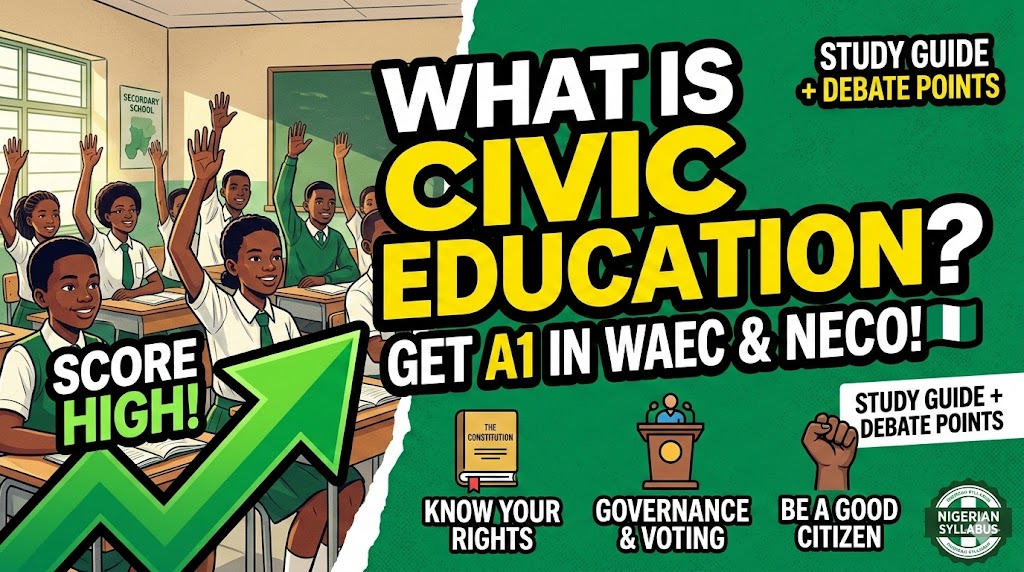
Understanding What is Civic Education
Are you staring at your lesson notes feeling entirely overwhelmed? Many secondary school students in Nigeria struggle to wrap their heads around government concepts right before WAEC and NECO exams.
I see it every single year. You are probably asking yourself exactly what is civic education and why does it matter so much to your final grades? Don’t panic.
We will fix that right now. This guide breaks down the core definition, key topics, and exam strategies for this mandatory subject. You will learn the exact syllabus expectations and how to pass without pulling all-nighters. Let’s get to work.
Before You Begin: The Mindset Shift
Preparing for this subject requires shifting from rote memorization to real-world application. Civic education bridges the gap between theoretical governance and your daily life as a Nigerian citizen. Understanding this connection instantly makes studying the material faster, easier, and heavily practical for upcoming board examinations.
In my years of helping SS3 students prep right here in Ikorodu, I always notice one glaring mistake. Students treat the subject like a distant, boring history lesson. It is not. It is happening all around you right now. Change your perspective. Think of this class as a user manual for surviving and thriving in Nigeria.
Exactly What is Civic Education?
What is civic education? It is the study of the theoretical, political, and practical aspects of citizenship, alongside its rights and duties. It teaches individuals how to actively participate in their communities, understand government functions, and uphold democratic values within a structured society like Nigeria.
When someone asks you what is civic education, you can confidently say it is the roadmap to being a responsible citizen. It goes beyond just passing an exam. It shapes your worldview. You learn your rights. You learn your boundaries. Let us break down the exact pillars you need to master.
1. The Core Pillars of Citizenship
Citizenship forms the absolute foundation of the syllabus. It defines the legal relationship between an individual and the state. Students must master how citizenship is acquired, the fundamental human rights guaranteed by the Nigerian Constitution, and the corresponding civic obligations owed to the nation.
You will see questions on this in almost every past paper. Examiners want to know if you understand the difference between citizenship by birth, naturalization, and registration. Pay close attention to these distinctions. They are easy marks if you memorize the specific constitutional requirements.
2. Understanding Democratic Governance
Democratic governance details how power is distributed and exercised within a republic. The curriculum covers the three branches of government, the rule of law, and electoral processes. Grasping these mechanics is essential for recognizing how policies are made and how leaders are held accountable.
You must know who does what. The separation of powers keeps any single group from taking total control. Here is a quick breakdown to keep in your notes:
| Branch | Primary Function | Nigerian Example |
| Executive | Enforces the laws | The President, Governors, Ministers |
| Legislative | Makes the laws | National Assembly (Senate & House of Reps) |
| Judiciary | Interprets the laws | Supreme Court, High Courts, Judges |
3. National Values and Social Issues
National values focus on the moral framework holding a country together. Topics include honesty, discipline, and patriotism. Additionally, the syllabus addresses pressing social issues like cultism, drug abuse, and human trafficking, testing a student’s awareness of societal dangers and preventative community measures.
WAEC loves essay questions on this section. They test your ability to think critically about community problems. Always structure your answers by first defining the social issue, listing the causes, explaining the devastating effects on society, and finally offering realistic solutions.
4. The Electoral Process in Nigeria
The electoral process section explains how leaders are chosen through voting. It outlines the duties of the Independent National Electoral Commission, the stages of organizing a free and fair election, and the critical importance of voter registration and political participation for democratic stability.
This is highly relevant today. According to the West African Examinations Council (WAEC), mastering the functions of an electoral body is a frequent requirement for Section B essays. Be ready to list at least five functions of INEC off the top of your head.
How to Pass Civic Education in WAEC
Passing the exam requires strategic preparation rather than last-minute cramming. Review the official syllabus thoroughly, practice past objective questions, and learn to write structured essay answers. Focus heavily on current affairs, legal definitions, and applying constitutional principles to real-world Nigerian case studies effectively.
Stop reading your textbook like a novel. You need a system. Follow this exact workflow to guarantee a strong grade:
-
Download the Syllabus: Do not study blindly. Get the official document and tick off topics as you understand them.
-
Master the Objective Questions: Spend 20 minutes a day drilling past papers. These questions repeat frequently.
-
Structure Your Essays: Always use clear headings in your exam booklet. Bullet points are your friend. Make the examiner’s job easy.
-
Relate to Current Events: Use actual Nigerian events as examples in your essays. It shows deep comprehension.
Now that you fully grasp what is civic education, you are ready to tackle your notes with real confidence. You can absolutely excel at this subject.