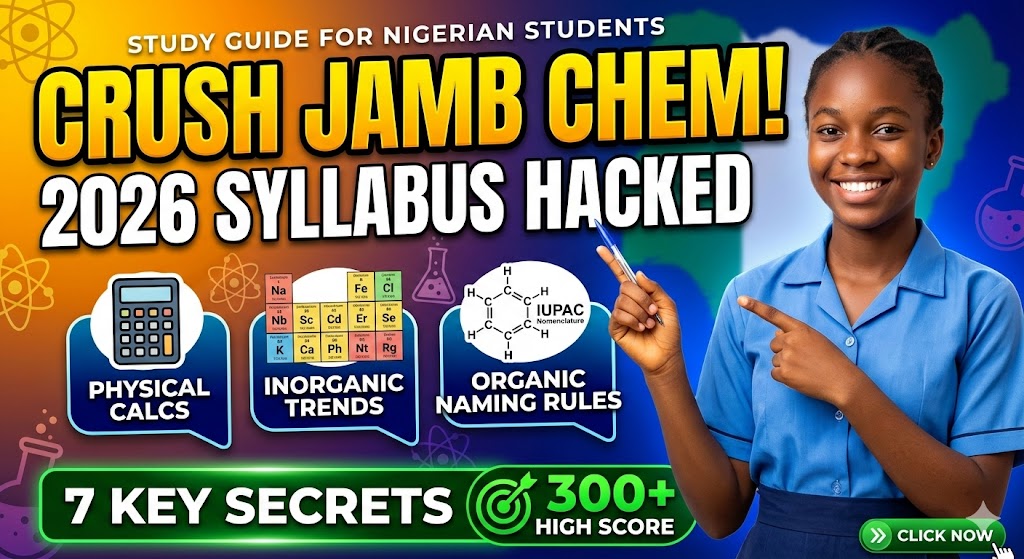
Secrets to Crushing the JAMB Syllabus for Chemistry 2026
Many students panic. They stare at textbooks thicker than bricks. But passing isn’t about reading everything under the sun. It is about reading smart.
In my years of helping SS3 students in Ikorodu prepare for WAEC and UTME, I’ve watched brilliant kids bomb their science papers. Why? They ignored the blueprint. They read blindly. You need laser focus. The right guide changes everything. Today, we are tearing down the jamb syllabus for chemistry 2026 so you know exactly what to study, what to skip, and how to guarantee a massive score. We will map out the heavily tested areas right now.
Decoding the Official Blueprint
The jamb syllabus for chemistry 2026 outlines exactly 18 core topics divided across physical, inorganic, and organic domains. This regulatory blueprint dictates every single question tested in the UTME. Candidates must thoroughly master chemical combinations, gas laws, atomic structures, and complex organic nomenclature to consistently achieve scores exceeding 280.
You cannot outsmart the Joint Admissions and Matriculation Board. They follow a strict pattern. If a topic is not in this document, it will not appear on your computer screen. Period.
Stop wasting time on advanced university-level mechanisms. Stick to the basics. The exam tests your speed, accuracy, and foundational grasp of core scientific principles.
Section A: Physical Chemistry and Calculations
Physical chemistry evaluates your mathematical reasoning and fundamental understanding of particulate matter. Required topics include basic stoichiometry, gas laws, atomic bonding, chemical kinetics, and thermodynamics. You must actively memorize core formulas, master the mole concept, and learn to calculate reacting masses accurately without using any programmable or scientific calculators.
This section will test your brain. You will face questions on Boyle’s law, Charles’ law, and Graham’s law of diffusion. The trick here is unit conversion. Always convert temperatures to Kelvin.
Make sure you understand separation techniques. You will definitely see questions asking you to differentiate between fractional distillation and simple crystallization.
Section B: Inorganic Chemistry and Elements
Inorganic chemistry focuses intensely on the periodic table, non-metals, metals, and everyday environmental chemistry. The syllabus requires candidates to completely understand metal extraction processes, properties of halogens, transition metals, and water hardness. Expect frequent, repetitive questions covering solubility curves, pollutant effects, and the large-scale industrial preparation of essential chemical compounds.
Memorize the first 20 elements. Know their atomic numbers and mass numbers by heart. You also need to spot periodic trends instantly.
Understand how electronegativity, ionization energy, and atomic radii change across a period and down a group. Also, pay close attention to the Contact Process and the Haber Process.
Section C: Mastering Organic Chemistry
The organic chemistry section of the jamb syllabus for chemistry 2026 demands strict memorization of molecular structures and diverse functional groups. Key examinable topics cover aliphatic hydrocarbons, alkanols, alkanoic acids, complex amines, and vital biomolecules. You must deeply understand IUPAC nomenclature rules, specific esterification reactions, and the fundamentals of polymer chemistry.
Many candidates run away from organic chemistry. Do not make this mistake. It is arguably the easiest section to score points if you know the naming rules.
Focus heavily on cracking and reforming of petroleum. Learn the chemical tests for different functional groups, like using bromine water to test for unsaturation in alkenes.
Core Focus Breakdown
To give you a clearer picture, here is a quick overview of what to expect on exam day:
| Chemistry Branch | Core Focus Areas | Expected Difficulty |
| Physical | Gas laws, mole concept, electrolysis | High (Calculation heavy) |
| Inorganic | Periodic trends, metal extraction, water | Medium (Memorization) |
| Organic | IUPAC naming, hydrocarbons, alkanols | High (Structural logic) |
Proven Preparation Strategies for UTME Candidates
Scoring incredibly high requires deliberately combining the official syllabus with strategic, daily timed practice. Students should pair recommended textbooks like New School Chemistry alongside a massive bank of recent past questions. Tracking your calculation speed, recognizing hidden repeated patterns, and memorizing periodic trends will drastically improve your overall exam performance.
Stop reading like you have all day. The UTME CBT gives you roughly 40 seconds per question. Speed is everything.
-
Study actively: Use flashcards for organic functional groups.
-
Practice calculations: Solve stoichiometry problems without a scientific calculator. Get used to the basic on-screen CBT calculator.
-
Review past papers: Focus on questions from 2015 to 2025. You will spot massive repetition.
Accessing and Using the Official Document
You can easily download the official jamb syllabus for chemistry 2026 directly from the regulatory board’s approved online portal. Saving the lightweight PDF to your mobile phone allows for constant offline tracking. Cross-reference your secondary school notes with this specific document every single day to ensure absolute topical coverage.
Here is exactly how to get it:
-
Open your browser and visit the JAMB Official Portal.
-
Navigate to the “IBASS” or Syllabus section on the main menu.
-
Select “Chemistry” from the dropdown list of subjects.
-
Click the download icon to save the document directly to your device.
Mastering the jamb syllabus for chemistry 2026 is your guaranteed ticket to your dream university. Take a deep breath. Gather your materials. Start tackling these topics one by one. You have the intelligence and the drive to crush this exam.