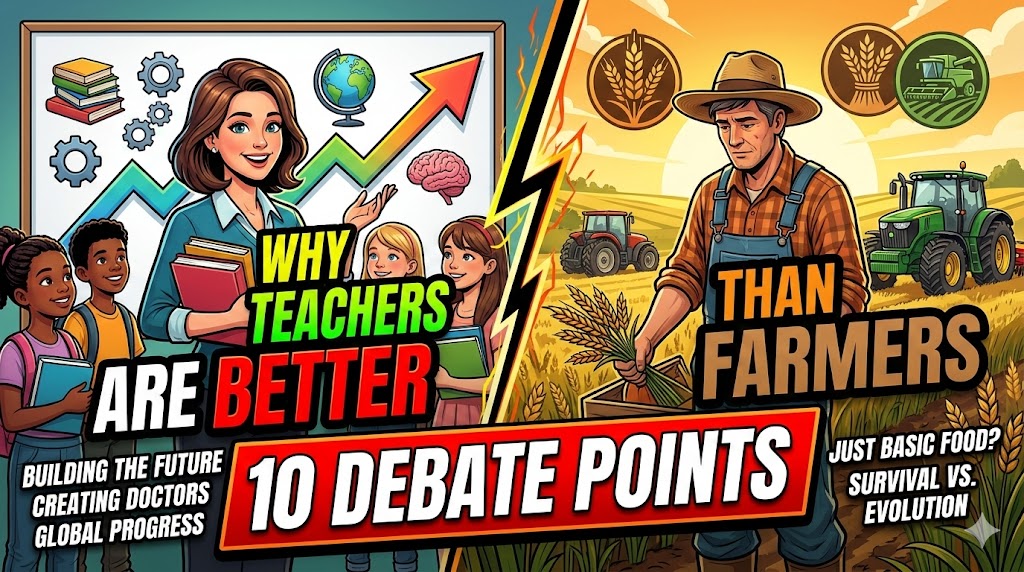
Why Teachers Are Better Than Farmers: 10 Debate Points
Why Teachers Are Better Than Farmers
We all eat. That is a basic fact of life. Because of this, many people quickly assume that those who grow our food hold the most important job in society. But let’s look deeper. When we look past the dinner table and into the foundation of human progress, a strong argument emerges that teachers are better than farmers in driving civilization forward.
Without agriculture, we could not survive. Nobody is arguing that. But mere survival is not enough. We want to thrive, build, cure diseases, and reach the stars. This is where education steps in. A farmer feeds the body for a day. A teacher feeds the mind for a lifetime, unlocking the potential to solve every problem we face.
Let’s break down the logic behind this stance. Here are the core arguments supporting this perspective in a clear, structured debate format.
10 Reasons Why Teachers Are Better Than Farmers
1. Education Creates Better Farmers
Modern agriculture is highly scientific. Farmers don’t just throw seeds in the dirt anymore. They use complex machinery, understand soil chemistry, and track weather patterns. Where do they learn all this? From educators.
Without teachers, agricultural science would stall. We wouldn’t have agronomists developing drought-resistant crops or engineers building better tractors. Teachers actually make farming possible on a massive, global scale.
The person who imparts the knowledge is the root of the success. By teaching the people who grow our food, educators indirectly feed the world while also advancing the methods used to do it.
2. Teaching Drives All Other Professions
Think about the person who saves your life in a hospital. The doctor would not know what medicine is, how to diagnose illnesses, or even how to communicate without years of education. Every single profession depends entirely on the teaching profession.
A farmer only grows food. They do not build hospitals, write laws, or design the internet. Teachers sit at the very base of the professional tree.
They are the ultimate multipliers of human capability. This makes them structurally more vital to a complex, functioning society. You can have a society without farmers if you synthesize food, but you cannot have a society without teachers.
3. Intellectual Nourishment Over Physical Nourishment
Food keeps the physical body alive. That is completely true. But what makes us human is our mind. Animals eat to survive, but humans learn to evolve.
Intellectual nourishment pushes us past basic survival instincts. It moves us into the space of human achievement, art, and science. If we only had farmers, we would be well-fed but totally stagnant.
We would be stuck in the past. Teachers provide the spark that lifts humanity out of the mud and into the future. That is a far greater contribution to human destiny.
4. Crisis Resolution
When a massive drought hits, a farmer alone cannot stop it. They suffer the consequences just like the rest of us. It takes highly educated minds to figure out long-term solutions to complex issues.
Climatologists, policy makers, and engineers are the ones who fix global crises. And who trained those experts? The educators.
If we want to argue that teachers are better than farmers, we just have to look at how society survives its biggest threats. Knowledge is the ultimate tool for survival. Without the problem-solvers produced by teachers, one bad crop season could wipe us out.
5. The Ripple Effect of Knowledge
A farmer grows a tomato. You eat the tomato, and it is gone. The cycle has to start all over again the next day. The output of a farm is entirely temporary.
Knowledge is permanent. When a teacher teaches a child how to read, that child uses that skill every single day for the rest of their life. They then pass that knowledge to their own children.
Education creates a permanent ripple effect that physical food simply cannot match. An idea taught today can still be changing the world a thousand years from now.
6. Economic Growth Stems from Education
Look at the wealthiest, most stable nations in the world. Are they the ones that only focus on farming? No. They are the countries with the best educational systems.
The modern economy runs on ideas, technology, and services. Countries rely on highly educated workforces to compete globally. Economic prosperity is heavily tied to literacy rates and higher education, as noted by the World Bank.
A society of farmers without teachers would remain economically poor. Wealth and better living conditions come directly from the classroom.
7. Social Order and Morality
We don’t just learn math and science in school. We learn how to interact with others. Teachers instill values, discipline, and a sense of civic duty in young minds.
They teach us how to be good citizens. Without this social conditioning, society falls into chaos. A full stomach does not prevent crime. It does not build a fair justice system either.
Moral and social education is what keeps civilization from collapsing onto itself. Teachers maintain the peace by showing us how to live together.
8. Adaptability in a Changing World
The world is changing faster than ever. The farming industry is becoming heavily automated right now. Machines can plant, water, and harvest crops with very little human intervention.
The physical labor of farming is slowly being replaced by technology. You cannot easily automate a teacher.
The empathy, patience, and adaptability required to help a struggling student understand a new concept are uniquely human traits. The teaching profession remains irreplaceable even as technology takes over the fields.
9. Empowering the Next Generation of Innovators
Every child has hidden potential. They might have the mind to cure a disease. They might invent a clean energy source. But raw talent means nothing without guidance.
Teachers are the ones who recognize and nurture that spark. A farmer sustains the present. A teacher builds the future.
By empowering the next generation to think bigger and do better, teachers ensure that tomorrow is brighter than today. They are the architects of human potential.
10. The Ultimate Foundation of Civilization
Let’s look at the very definition of civilization. It is not just a group of people living together. It is art, science, law, and shared culture.
None of these things exist without the transfer of knowledge from one generation to the next. While we absolutely need food to exist, existing is just the baseline. Teaching is the engine of progress.
When evaluating who has the higher impact on the total human experience, it becomes clear why teachers are better than farmers. They build the mind, and the mind builds absolutely everything else.
Conclusion
At the end of the day, both professions are necessary. Pitting them against each other highlights what we value most as a society. While the farmer sustains our physical bodies, the teacher sustains our humanity.
Without agriculture, we perish. But without education, we are just smart animals living in the dirt. Teachers lift us up. They build the foundation for every other success we enjoy, including the food on our tables. That is the true, unmatched power of education.