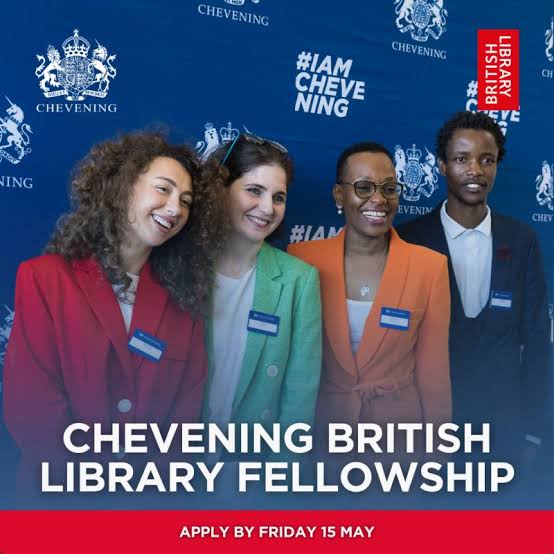
Chevening British Library Fellowship in UK 2026: Eligibility, Deadline and How to Apply
The Chevening British Library Fellowship in UK 2026 is not just one generic fellowship. In the current 2026–27 cycle, the phrase refers to two relaunched British Library fellowships under Chevening: the Chevening Southeast Europe British Library Fellowship and the Chevening Overseas Territories in the Atlantic and Caribbean British Library Fellowship.
Chevening announced the relaunch in March 2026, with one place available for each fellowship, and both are open for applications until 15 May 2026 at 12:00 UTC.
That distinction matters because a lot of applicants search the umbrella phrase and assume there is one open call for everyone. There is not. These fellowships are highly targeted, country-specific, and designed for mid-career professionals, researchers, and academics whose expertise connects directly to particular collections at the British Library. If you do not match the country list and the subject profile, the application will not be competitive, and in some cases will not be eligible at all.
Quick summary of the fellowship
Here is the practical version first:
-
Host: British Library
-
Funder: Co-funded by the British Library and the UK Foreign, Commonwealth and Development Office
-
Location: United Kingdom
-
Application deadline: 15 May 2026 at 12:00 UTC
-
Duration: 12 months
-
Start date: January 2027
-
Places: One place in each fellowship track
-
What it covers: living expenses, return economy airfare, allowance for fellowship-related activities, and up to £1,000 for approved project-related expenses
-
Who it targets: mid-career professionals with strong subject knowledge and significant experience in relevant fields
What the Chevening British Library Fellowship in UK 2026 actually is
At its core, this opportunity is a professional and research-based fellowship, not a taught academic degree and not a standard scholarship. The British Library and Chevening are using these fellowships to bring in experienced professionals who can work directly with collections, help improve access and interpretation, and produce research or public-facing outputs that strengthen understanding of underrepresented histories and materials.
That gives the fellowship a very different profile from many UK opportunities. It is not meant for fresh graduates testing the waters. It is aimed at people who already have a body of work, professional credibility, and enough subject knowledge to contribute meaningfully inside a world-class cultural institution. Chevening’s own fellowship guidance describes fellowships as being for mid-career professionals who want to expand their knowledge, networks, and potential through tailored placements, research, or short-course experiences in the UK.
The two British Library fellowships under this 2026 call
Southeast Europe British Library Fellowship
This track is open to applicants from Albania, Bosnia and Herzegovina, Kosovo, Moldova, Montenegro, North Macedonia, Serbia, and Turkey. It focuses on the British Library’s historic Southeast European collections and asks the fellow to work on improving collection records, analysing data, and producing research and written outputs that make the region’s intellectual heritage more visible and easier to access. The fellowship page also notes that the Library has identified around 30,000 historic Southeast European items whose metadata can now be improved at scale.
This is a strong fit for applicants whose work sits at the intersection of regional history, cultural heritage, metadata, archives, digital humanities, or library and information work. It is not just about having an academic interest in the Balkans. The role expects language ability, dataset-related work, and the ability to translate specialist knowledge into useful outputs for wider audiences.
Overseas Territories in the Atlantic and Caribbean British Library Fellowship
This second track is open to applicants from Anguilla, Bermuda, British Virgin Islands, Cayman Islands, Falkland Islands, Montserrat, St Helena, and Turks and Caicos Islands. The fellowship is based in the Eccles Institute for the Americas and Oceania at the British Library and focuses on how British Overseas Territories in the Atlantic and Caribbean are represented in the Library’s collections. Fellows are expected to create a collection guide, publish two blogs, prepare two presentations, and produce one report on the cultural and educational landscape of the territories.
This version is clearly more than a passive research attachment. It asks the fellow to interpret collections, connect them to real communities, and help shift how these territories are understood inside a major British institution. That makes it especially relevant for humanities researchers, heritage specialists, and library professionals with deep regional knowledge and strong public-facing communication skills.
Who can apply for the Chevening British Library Fellowship in UK 2026
The safest way to answer this is in layers.
First, you must meet the general Chevening Fellowship rules. That includes being a citizen of an eligible country or territory, showing leadership potential, returning to your country of citizenship after the fellowship, not holding British or dual British citizenship, and not having received UK government scholarship funding, including Chevening, within the last five years. Chevening also excludes certain current or recent employees and relatives of UK government-linked institutions under its published rules.
Second, you must match the specific country list for the fellowship track you are choosing. This is not a global open call. Each of the two British Library fellowships has a defined group of eligible countries or territories, and the programme pages say you must also be resident in one of those places at the point of application.
Third, you must have the right experience level and profile. Chevening’s general fellowship work-experience guidance says applicants must meet the minimum work experience required by their chosen programme, and for fellowships that usually means at least five years in a relevant field, equivalent to 7,200 hours. Eligible work can include full-time or part-time employment, voluntary work, and paid or unpaid internships.
General Chevening fellowship eligibility rules
Before you get too deep into the British Library specifics, check the non-negotiables:
-
you must be a citizen of a fellowship-eligible country or territory
-
you must return to your country of citizenship after the fellowship
-
you must meet programme-specific rules
-
you must not hold British or dual British citizenship
-
you must not have had UK government scholarship funding within the last five years
-
you must not fall into Chevening’s restricted employment and family-relationship categories listed in its eligibility rules
That may sound procedural, but this is where many ineligible applications begin. Applicants often focus on the interesting research theme and ignore the formal restrictions. Chevening does not treat those as minor details.
Programme-specific requirements you must check carefully
For the Southeast Europe fellowship, the extra requirements are substantial. In addition to the standard Chevening rules, applicants must be resident in one of the listed countries, have advanced proficiency in at least two Southeast European languages, hold a postgraduate-level qualification or equivalent training or experience, have at least five years of significant professional or research experience, be currently employed or currently enrolled in a PhD that is not with a UK, EU, or USA university, and have experience working with large datasets or computational methods in a library and information context.
For the Overseas Territories fellowship, the page asks for a citizen resident in one of the listed territories, a strong background in humanities research or library work involving collections development and management, in-depth knowledge of the history or culture of one or more territories, strong research and communication skills, computer proficiency including Excel, a postgraduate-level qualification or equivalent, and at least five years of significant professional or academic research experience.
This is why a broad “fully funded UK fellowship” mindset is not enough here. These are specialist placements, and the selectors are likely looking for candidates who already know how to contribute from day one.
What the fellowship covers
Both British Library fellowships offer the same published funding structure: a 12-month period of project-based activity at the British Library, living expenses for the duration, return economy airfare, an allowance package for fellowship-related activities, and up to £1,000 for approved project-related expenses.
That makes the opportunity meaningfully funded, but the bigger value is not only financial. Fellows also gain institutional visibility, access to rare primary sources, support from curators and specialist colleagues, and the chance to publish research or outputs under the umbrella of a globally recognized cultural institution. For the right applicant, that professional leverage may matter as much as the funding itself.
Duration, location, and expected outputs
Both fellowships run for 12 months, starting in January 2027 and ending in December 2027 or January 2028. That timing matters because the keyword includes 2026, but the actual fellowship placement happens mainly in 2027. The 2026 piece is the application cycle, not the fellowship start date.
The outputs also differ by track. The Southeast Europe fellow is expected to work with metadata, datasets, research, and written outputs such as blog posts and collection guides. The Overseas Territories fellow has more explicitly listed outputs, including a collection guide, two blogs, two presentations, and one report. These are not vague promises of “exposure.” They are concrete deliverables.
Required documents and application preparation
The British Library fellowship pages focus more on eligibility and programme design than on a long checklist of initial uploads. What Chevening clearly states across its application guidance is that applicants provide the names and contact details of two referees in the application, and if shortlisted for interview, they must upload two reference letters before the interview deadline. Chevening also says invited candidates may need to provide identification and other supporting documents through the online system ahead of interview.
In practical terms, applicants should prepare:
-
a strong, current CV
-
accurate work history with dates and hours
-
two referees who can speak credibly about leadership, research ability, and professional character
-
proof of postgraduate qualification or equivalent professional standing where relevant
-
a clear explanation of why their expertise fits the exact fellowship theme
The official pages do not present this as a casual application. The clearer and more evidence-based your file is, the better.
Deadline and application timeline
The most important date is straightforward: both British Library fellowships are open until 15 May 2026 at 12:00 UTC.
After submission, the process moves into Chevening’s wider selection flow. Chevening’s guidance says shortlisted candidates are invited to interview, and reference letters must be uploaded no later than seven working days before the interview. That matters because some applicants wait until they are shortlisted before contacting referees, which is usually too late for a strong turnaround.
How to apply step by step
1. Identify the correct British Library fellowship track
Do not apply under the umbrella keyword alone. Confirm whether you fit the Southeast Europe route or the Overseas Territories in the Atlantic and Caribbean route. Your citizenship, residence, and subject expertise have to match the specific page.
2. Read the programme-specific eligibility line by line
This fellowship is selective enough that one missed criterion can end the process. Language requirements, experience thresholds, research background, and current employment or PhD status matter here.
3. Submit your application through the Chevening system
The programme pages link applicants to the Chevening application system. Chevening’s guidance says applications are submitted online, and work experience entries are used to calculate whether applicants meet the relevant requirement.
4. Prepare your referees early
Chevening requires referee details in the application and later requires full reference letters if you progress. Waiting until shortlist stage to think about references is one of the easiest ways to create unnecessary stress.
5. Get interview-ready before you are invited
Because this is a fellowship for established professionals, the likely pressure points are easy to predict: leadership, subject relevance, public value of your proposed contribution, and why the British Library is the right place for your work. Even before an interview invitation arrives, applicants should be ready to explain those points clearly.
Tips to improve your chances
The strongest applications will do more than prove eligibility. They will show fit.
A good applicant for the Southeast Europe fellowship should make it obvious that they can handle multilingual material, metadata or dataset work, and historically grounded research. A good applicant for the Overseas Territories fellowship should make it obvious that they can connect archival collections to real communities, historical interpretation, and public-facing outputs.
It also helps to think like a selector. These fellowships are hosted by a major cultural institution, so selectors are not just asking, “Is this person impressive?” They are asking, “Can this person produce useful, credible work in our collections environment?” Your CV, statement, and references should answer that before anyone has to guess.
Common mistakes to avoid
A common mistake is treating the Chevening British Library Fellowship in UK 2026 like a broad international fellowship open to any strong researcher. It is not. Country eligibility is narrow, and the thematic fit is tight.
Another mistake is overlooking the work-experience requirement. Chevening’s fellowship guidance puts the baseline at five years in a relevant field, and both programme pages reinforce that with their own five-year research or professional-experience expectations.
A third mistake is submitting a generic application that sounds like it could fit any arts or heritage fellowship. These programmes are not generic. They are built around specific collections, regions, and outputs. The closer your application gets to the actual work described on the page, the stronger it becomes.
Important notes before you submit
There are two final points worth keeping in mind. First, the relaunch announcement says there is one place available for each fellowship, which tells you immediately how selective this will be.
Second, the keyword includes “2026,” but the fellowship itself begins in January 2027. That can confuse applicants who expect immediate departure in 2026. Think of this as a 2026 application cycle for a 2027 placement. Getting that timeline right will help you plan work commitments, referee timing, and professional availability more realistically.
FAQ Section
Is the Chevening British Library Fellowship in UK 2026 currently open?
Yes. Both British Library fellowship tracks in the 2026–27 cycle are open for applications until 15 May 2026 at 12:00 UTC.
Is this one fellowship or two different fellowships?
It is best understood as an umbrella term covering two different fellowships: the Chevening Southeast Europe British Library Fellowship and the Chevening Overseas Territories in the Atlantic and Caribbean British Library Fellowship.
What does the fellowship fund?
The published benefits include living expenses for the duration, return economy airfare, an allowance package for fellowship-related activities, and up to £1,000 for approved project-related expenses.
How long does the fellowship last?
Each fellowship lasts 12 months, with a start date in January 2027 and an end date in December 2027 or January 2028.
How much work experience do I need?
Chevening’s fellowship guidance says the usual minimum is five years of relevant work experience, equivalent to 7,200 hours, and both British Library fellowship pages also require at least five years of significant professional or research experience.
Can anyone apply from any country?
No. Each fellowship has a restricted list of eligible countries or territories, and applicants must also be resident in one of those places at the point of application.
What references do I need?
Chevening says applicants provide the names and contact details of two referees in the application, and shortlisted candidates must upload two reference letters before the interview deadline.
Conclusion
The Chevening British Library Fellowship in UK 2026 is a serious, specialist opportunity for mid-career professionals who already have the experience, regional knowledge, and research or collections background to contribute at a high level. The main thing applicants need to understand is that this is not one broad fellowship but two distinct British Library fellowships, each with its own country list and profile, both closing on 15 May 2026 at 12:00 UTC.
The smartest next step is to stop thinking in broad terms and match yourself to the exact track you qualify for. Read the programme-specific requirements carefully, prepare your referees early, and shape your application around the actual collections work the fellowship expects. That is the difference between merely noticing the Chevening British Library Fellowship in UK 2026 and applying for it well.