Is Chunking More Effective Than Rote Memorization?
Is Chunking More Effective Than Rote Memorization?
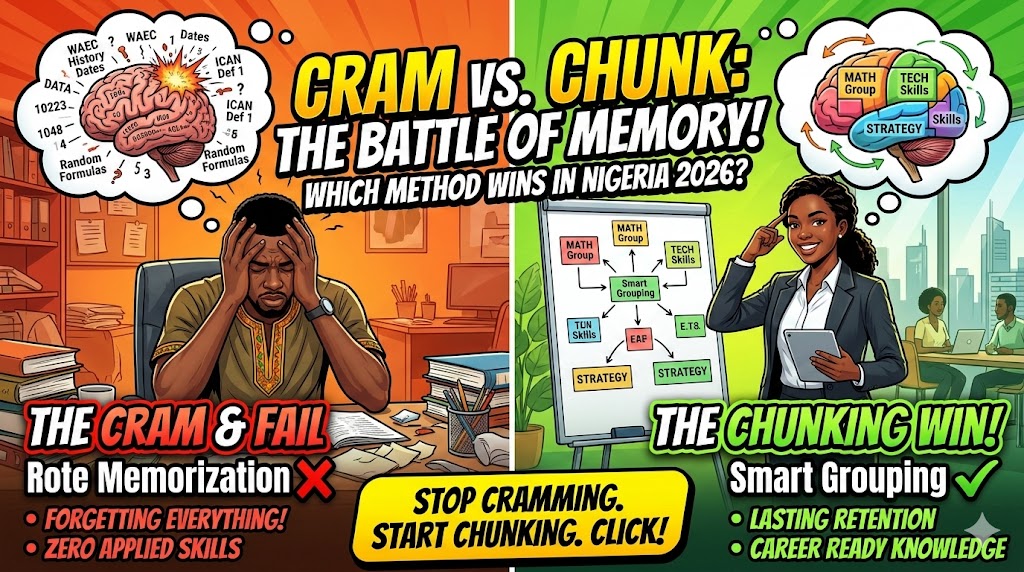
If you are still relying on brute-force memorization in 2026, you are setting yourself up for massive failure in the actual job market. Companies don’t pay you to recite definitions; they pay you to solve problems. I get asked this exact question a lot by struggling professionals and students alike: Is Chunking More Effective Than Rote Memorization? Yes. It’s not even a debate.
Rote learning is practically dead. Here is the raw truth on why this is the case, and exactly how you can start studying smarter, not harder.

Quick Steps to Implement Chunking Today:
-
Break massive information into small, digestible pieces.
-
Find patterns, similarities, or connections between these pieces.
-
Group them into meaningful, logical categories.
-
Use acronyms or visual associations to label each group.
-
Practice retrieving these broad categories instead of isolating single facts.
Mastering Your Brain: Is Chunking More Effective Than Rote Memorization?
1. Stop the Brute Force Approach
The traditional way we study is fundamentally flawed. That is rote memorization. You repeat a definition fifty times until it temporarily sticks in your short-term memory. But what happens during a high-stakes job interview or a practical exam when they ask you to actually apply that concept? You freeze. The reality is that your brain’s cognitive load has a strict, biological limit. You cannot hold 20 random, unconnected facts in your head at once and expect to use them effectively. It just doesn’t work.
2. Group Information to Bypass Mental Limits
Here’s the thing about chunking. It takes those 20 chaotic facts and groups them into 4 or 5 logical blocks. Think about how you remember phone numbers. You don’t memorize eleven isolated digits. You naturally group them: 0803 – 123 – 4567. That is chunking in action. When people constantly ask me, Is Chunking More Effective Than Rote Memorization?, I point them straight to how our brains naturally organize data for long-term retention. You are literally hacking your brain’s storage system.
3. Connect New Concepts to Existing Knowledge
To truly master this method, you have to link new, alien information to things you already understand. If you are studying for a tech certification, don’t just stare blankly at the syllabus. Group related topics together. If you’re learning software development, group HTML, CSS, and JavaScript into one “frontend visual” chunk in your mind. This drastically reduces the mental heavy lifting. If you want to understand the science behind this, read up on how the brain builds neural connections to see exactly why logical grouping completely destroys pure repetition.
4. Use Acronyms and Patterns as Anchors
We are actually naturally good at this in Nigeria. Think of “BODMAS” from primary school. You didn’t memorize five complex, separate mathematical rules; you memorized one single word that unlocked all five rules. That is a prime example of elite study techniques. If you want to stop failing professional exams and certifications, start creating your own acronyms and stories for complex theories. It is a highly effective way to build active recall without sweating blood over your desk.
5. Test Yourself on the Chunks, Not the Details
Let’s address the big question again: Is Chunking More Effective Than Rote Memorization? Yes, because it fundamentally changes how you evaluate yourself. Instead of driving yourself crazy trying to remember paragraph three of page fifty, you just need to recall the “chunk” label. Once you remember the label, your brain naturally unpacks the specific details inside it. Practice retrieving the main categories first. The details will follow. If you are curious about the psychology behind why this works so flawlessly, the American Psychological Association has excellent resources explaining effective learning strategies and memory.
Final Thoughts on Upgrading Your Study Habits
-
Rote memorization is a trap that only helps you pass an exam today and leaves you empty tomorrow.
-
Chunking drastically reduces your mental burden by organizing pure chaos into recognizable patterns.
-
Always look for connections and create acronyms when you are facing massive, intimidating study materials.
-
Your value in the current job market is based entirely on application, not memorization. Learn to actually understand the concepts.
Frequently Asked Questions
Does chunking work for mathematics and calculations?
Yes, absolutely. Instead of memorizing raw, complex formulas, you chunk them by their underlying principles or the specific scenarios where they apply. Once you recognize the problem type (the chunk), the correct formula naturally comes to mind.
Is Chunking More Effective Than Rote Memorization for learning a new language?
Without a doubt. Rote learning long vocabulary lists is exhausting and inefficient. Chunking involves grouping words by context or specific themes (like “restaurant vocabulary” or “travel words”). This context helps your brain retrieve the exact words much faster during a real, spontaneous conversation.
Can I combine rote memorization and chunking?
You can, but do it sparingly. Sometimes you just have to memorize a raw fact, like a specific historical date or a mathematical constant. However, the smart play is to immediately place that memorized fact into a larger, meaningful chunk so you actually retain it for the long haul.