What is the most educated tribe in Northern Nigeria?
In my years of helping students prepare for WAEC and national debate tournaments, I always see students struggle with regional facts. They get confused by the sheer size of the North.
You need hard facts, not rumors. If you’re asked, What is the most educated tribe in Northern Nigeria?, you need to know exactly how to answer. This guide breaks down the historical context, Western versus Islamic literacy, and the specific ethnic groups leading the charts. We will look at the Middle Belt’s advantage, the Tiv and Idoma people, and how the core North approaches scholarship. Let’s get straight into the facts.
Before You Begin: Defining “Education” in the North
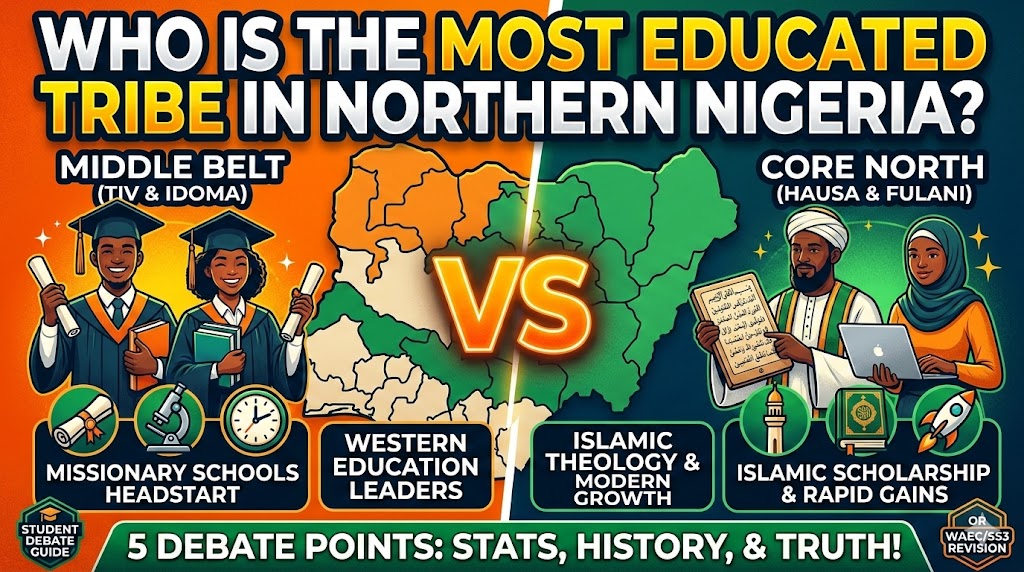
When asking what is the most educated tribe in Northern Nigeria, you must separate Western education from Islamic scholarship. Core Northern tribes like the Hausa have centuries of advanced Qur’anic education. However, regarding formal Western literacy, Middle Belt tribes currently lead the region statistically.
Most textbooks skip this nuance. Before the British even arrived, the Hausa-Fulani empire already had a booming system of Islamic education. They were reading and writing in Arabic script. Scholars traded books across the Sahara.
But the curriculum was religious. When the British brought Western schools, the core North pushed back. They wanted to protect their culture. That decision changed everything.
Keep these three definitions in mind for your debate:
-
Western Literacy: Reading, writing, and formal schooling based on the English curriculum.
-
Islamic Scholarship: Classical Arabic, theology, and Qur’anic studies.
-
Geographic Zones: The North is technically split into the North-West, North-East, and North-Central (Middle Belt).
If you are arguing this point in front of judges, always clarify your terms. Are you talking about degrees from a university or classical Arabic scholarship? For modern job markets, Western literacy is the standard metric used by the National Bureau of Statistics.
The Historical Impact of Missionaries on the Middle Belt
Christian missionaries were largely restricted from the Muslim-dominated core North. Consequently, they settled in the Middle Belt region. They built hundreds of schools and hospitals. This early exposure gave minority Northern tribes a massive head start in Western education and civil service careers.
Lord Lugard made a promise to the Emirs. He swore not to interfere with their religion. So, the missionaries packed their bags. They moved downward into the North-Central region, commonly called the Middle Belt.
They set up shop among the Tiv, Idoma, Igala, and Southern Kaduna people. They built primary schools. They built secondary schools. They offered free education to anyone willing to learn.
This created a massive generational advantage. Parents who went to missionary schools sent their own kids to university. It became a snowball effect that changed the demographics of the region entirely.
The Tiv and Idoma of Benue State
The Tiv and Idoma tribes in Benue State are widely considered the most Western-educated groups in Northern Nigeria. Benefiting heavily from early missionary schools, these communities produce a disproportionately high number of university graduates, professors, and federal civil servants today.
Walk into any federal university today. You will find Tiv and Idoma professors everywhere. Benue State is often called the educational powerhouse of the North. The Tiv are the fourth largest ethnic group in Nigeria. They embraced formal schooling very early.
The Idoma did the exact same thing. During my time coaching debate teams in Abuja, my most formidable opponents often cited Benue’s literacy statistics. The parents there prioritize schooling above almost everything else. They will sell farm produce just to pay JAMB and WAEC fees.
The Igala of Kogi State and Southern Kaduna Tribes
Beyond Benue, the Igala people of Kogi State and the minority tribes of Southern Kaduna boast exceptional literacy rates. Their geographic proximity to the South and early adoption of missionary education integrated them rapidly into Nigeria’s formal academic and professional sectors.
Kogi State shares borders with several Southern states. This proximity rubbed off on the Igala people. They caught the education bug early.
Southern Kaduna is another hotspot. Tribes like the Atyap and Bajju have extremely high rates of secondary school completion. They realized quickly that government jobs required English and math. They adapted. They conquered the classroom.
When someone asks what is the most educated tribe in Northern Nigeria?, these groups must be central to your argument.
The Hausa and Fulani: Islamic Scholarship vs Western Education
The Hausa and Fulani tribes possess a rich, centuries-old heritage of Islamic and Qur’anic education. While their formal Western literacy rates historically lagged behind the Middle Belt, massive government interventions and nomadic education programs are rapidly closing this academic gap today.
Do not underestimate the core North. The Hausa and Fulani are incredibly learned. Their historical texts are profound. But the transition to Western classrooms was historically slow.
Many rural families preferred the Almajiri system. They trusted their local Mallams more than government teachers. Things are shifting now, however. Kano and Kaduna are pumping massive funds into public schools.
The Fulani nomadic education programs are finally yielding results. You see more Hausa youths dominating fields like medicine, engineering, and IT than ever before. The narrative is changing fast.
Statistical Breakdown: Comparing Literacy Rates
Recent educational data highlights a stark contrast within the region. While the national literacy average fluctuates, North-Central states consistently outperform the North-West and North-East in WAEC pass rates and youth literacy, proving the Middle Belt’s dominance in formal Western education.
Numbers do not lie. If you want to win a debate on what is the most educated tribe in Northern Nigeria?, you need hard data. You can pull data from UNICEF Nigeria to back up your claims. Let us look at how the regions stack up against each other.
| Region / Group | Primary Education Focus | Western Literacy Trend |
| Middle Belt (Tiv, Idoma, Igala) | Western / Missionary | Very High |
| Southern Kaduna Tribes | Western / Missionary | High |
| Core North (Hausa) | Dual (Islamic & Western) | Rapidly Improving |
| Nomadic (Fulani) | Specialized / Islamic | Slowly Improving |
This table gives you a quick snapshot. You can literally copy this onto your cue cards for your next presentation. The gap is still there, but state governments are working overtime to fix it.
Conclusion
Figuring out what is the most educated tribe in Northern Nigeria? requires looking past simple assumptions. You have to look at history. The Tiv, Idoma, and other Middle Belt tribes clearly hold the trophy for Western education thanks to the early missionaries. Meanwhile, the Hausa and Fulani hold a massive legacy of Islamic scholarship and are catching up quickly in the formal sector.